Tuesday, December 22, 2009

Real Estate Prices Not Yet Back to Trend

Home prices indices are reportedly dropping again after a shortlived rebound. (H/T CalculatedRisk)
The chart below looks at where home prices stand compared to a continuation of the trend from Jan 76 to Dec 99 (ex bubble years).

Prices are still well above the long term trend (ex bubble) and as the 90's episode illustrates prices have corrected below trend in the past. The rebound in prices might well have been short-lived. If prices stabilize at these level it would take a good 4 years for the trend to get there.

Monday, December 21, 2009

What Went Wrong

Great little wrap up on the crisis from Econbrowser. He highlights the US Treasury's recent proposal for reform of the financial system:
"
  • Introduce a legal mechanism whereby large financial institutions that are not commercial banks (such as AIG or Bear Stearns) can be liquidated in an orderly manner without bankruptcy or bailouts, analogous to the authority that the FDIC currently has to take over failing banks.
  • Subject the banklike functions of investment banks and structured investment vehicles (that is, the activity of borrowing short and lending long) to the same capital requirements as standard banking.
  • Require either mortgage originators or the mortgage securitizers to retain 5 percent of the product they create. I would take that idea a step farther, endorsing Princeton Professor Alan Blinder's proposal that originators and securitizers should each hold 5 percent.
  • Move the trading of financial derivatives like credit default swaps to centralized exchanges where they would be subject to a robust regime of regulation including conservative capital requirements, margins, and reporting requirements. To the Treasury's proposal, I would also recommend adding stop-loss provisions that regulators could use to limit the promises made and losses suffered by systemically important financial institutions as a result of their trading in financial derivative contracts.
  • Set guidelines for individual compensation systems at systemically important financial institutions in order to better align the personal rewards of traders with the interests of shareholders and the public."

Sunday, December 13, 2009

After the BRIC the BRINK

H/T Paul Kedrosky for pointing out to a new acronym via the WSJ. After the BRIC who defined oil demand in the past decade, the BRINK expected to define oil supply in the next one.
Brazil, Russia, Iraq, Nigeria and Kazakhstan: "Brazil has hosted a string of big discoveries, while Russia has defied expectations by overtaking Saudi Arabia's output. Kazakhstan is expanding three major projects, while a tentative peace is allowing Nigeria to start raising output.
The wild card is Iraq, where more licenses for foreign oil companies were awarded Friday. Contract terms encourage firms to maximize output quickly. Winners to date aim to boost output from five fields 12-fold to 8.5 million barrels per day."

Thursday, December 3, 2009

Pershing Square invests in Nestlé

Dealbook posts Pershing Square's latest quarterly comment in which they disclose their new investment in Nestlé. The stock seems to be the darling of famous investors. After Warren Buffett William A. Ackman has also become an investor. Their rationale can be read here. In Short Nestle, the world's largest food and beverage company has a great brand portfolio, it is gaining share in developped markets and growing in the high single to low teen in emerging markets. Pershing sees 1bn of annual cost cutting potential for the next few years and a 28bn cash bonanza if Nestle puts its Alcan shares to Novartis.

Peak in US Unemployment in 2011?

CalculatedRisk mentions Goldman Sachs' view:
The key features of our 2011 outlook: (1) a strengthening in growth from 2.1% on average in 2010 to 2.4% in 2011, with real GDP rising at an above-potential 3½% pace in late 2011; (2) a peaking in unemployment in mid-2011 at about 10¾%; (3) extremely low inflation – close to zero on a core basis during 2011; and (4) a continuation of the Fed’s (near) zero interest rate policy (ZIRP) throughout 2011.
The peak in unemployment is much later than suggested by CR's own look at housing starts and employment and also much later than what the Fed expects. As Paul Krugman reported here: "Well, the Fed expects unemployment to come down only very gradually — over 9 percent at the end of 2010, over 8 percent at the end of 2011, around 7 percent at the end of 2012. Inflation, meanwhile is expected to remain consistently below the Fed’s target."

Zirp could well last a while longer

Saturday, November 21, 2009

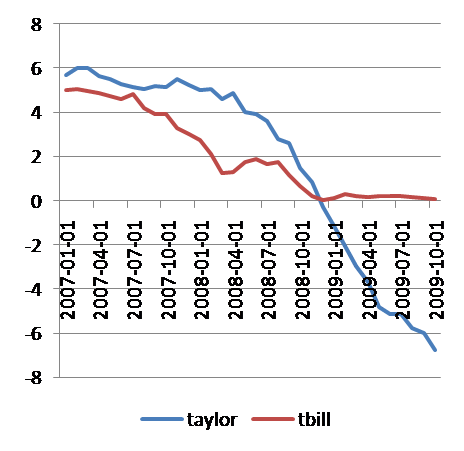
Fed Fund Rates and Taylor Rule

Paul Krugman has the chart and concludes: "Monetary tightening shouldn’t be on the agenda for a long, long time."

Saturday, November 14, 2009

Housing Starts and Unemployment Rate

CalculatedRisk has the chart and the explanations on a very close correlation between housing starts and the unemployment rate. Housing leads the economy and employment by 12 to 18months. According to CR this suggests unemployment may peak in spring 2010. Could central banks be tightening this coming summer? Earlier than suggested here.