From his 2008 shareholder letter:
On Private Equity:
"Some years back our competitors were known as “leveraged-buyout operators.” But LBO became a bad name. So in Orwellian fashion, the buyout firms decided to change their moniker. What they did not change, though, were the essential ingredients of their previous operations, including their cherished fee structures and love of leverage.
Their new label became “private equity,” a name that turns the facts upside-down: A purchase of a business by these firms almost invariably results in dramatic reductions in the equity portion of the acquiree’s capital structure compared to that previously existing. A number of these acquirees, purchased only two to three years ago, are now in mortal danger because of the debt piled on them by their private-equity buyers. Much of the bank debt is selling below 70¢ on the dollar, and the public debt has taken a far greater beating. The privateequity firms, it should be noted, are not rushing in to inject the equity their wards now desperately need. Instead, they’re keeping their remaining funds very private."
On quant / models:
"The type of fallacy involved in projecting loss experience from a universe of non-insured bonds onto a deceptively-similar universe in which many bonds are insured pops up in other areas of finance. “Back-tested” models of many kinds are susceptible to this sort of error. Nevertheless, they are frequently touted in financial markets as guides to future action. (If merely looking up past financial data would tell you what the future holds, the Forbes 400 would consist of librarians.)"
"Investors should be skeptical of history-based models. Constructed by a nerdy-sounding priesthood using esoteric terms such as beta, gamma, sigma and the like, these models tend to look impressive. Too often, though, investors forget to examine the assumptions behind the symbols. Our advice: Beware of geeks bearing formulas."
On Investing:
"Approval, though, is not the goal of investing. In fact, approval is often counter-productive because it sedates the brain and makes it less receptive to new facts or a re-examination of conclusions formed earlier. Beware the investment activity that produces applause; the great moves are usually greeted by yawns."
"When forced to choose, I will not trade even a night’s sleep for the chance of extra
profits."
On Derivatives:
"Derivatives are dangerous. They have dramatically increased the leverage and risks in our financial system. They have made it almost impossible for investors to understand and analyze our largest commercial banks and investment banks. They allowed Fannie Mae and Freddie Mac to engage in massive misstatements of earnings for years. So indecipherable were Freddie and Fannie that their federal regulator, OFHEO, whose more than 100 employees had no job except the oversight of these two institutions, totally missed their cooking of the books."
"The ridiculous premium that Black-Scholes dictates in my extreme example is caused by the inclusion of volatility in the formula and by the fact that volatility is determined by how much stocks have moved around in some past period of days, months or years. This metric is simply irrelevant in estimating the probabilityweighted range of values of American business 100 years from now. (Imagine, if you will, getting a quote every day on a farm from a manic-depressive neighbor and then using the volatility calculated from these changing quotes as an important ingredient in an equation that predicts a probability-weighted range of values for the farm a century from now.)"
Showing posts with label Buffett. Show all posts
Showing posts with label Buffett. Show all posts
Saturday, February 28, 2009

Must Read
Off to read Buffett's latest annual shareholder letter. I like and share his optimism:
"Amid this bad news, however, never forget that our country has faced far worse travails in the past. In the 20th Century alone, we dealt with two great wars (one of which we initially appeared to be losing); a dozen or so panics and recessions; virulent inflation that led to a 211⁄2% prime rate in 1980; and the Great Depression of the 1930s, when unemployment ranged between 15% and 25% for many years. America has had no shortage of challenges.
Without fail, however, we’ve overcome them. In the face of those obstacles – and many others – the real standard of living for Americans improved nearly seven-fold during the 1900s, while the Dow Jones Industrials rose from 66 to 11,497. Compare the record of this period with the dozens of centuries during which humans secured only tiny gains, if any, in how they lived. Though the path has not been smooth, our economic system has worked extraordinarily well over time. It has unleashed human potential as no other system has, and it will continue to do so. America’s best days lie ahead."
"Amid this bad news, however, never forget that our country has faced far worse travails in the past. In the 20th Century alone, we dealt with two great wars (one of which we initially appeared to be losing); a dozen or so panics and recessions; virulent inflation that led to a 211⁄2% prime rate in 1980; and the Great Depression of the 1930s, when unemployment ranged between 15% and 25% for many years. America has had no shortage of challenges.
Without fail, however, we’ve overcome them. In the face of those obstacles – and many others – the real standard of living for Americans improved nearly seven-fold during the 1900s, while the Dow Jones Industrials rose from 66 to 11,497. Compare the record of this period with the dozens of centuries during which humans secured only tiny gains, if any, in how they lived. Though the path has not been smooth, our economic system has worked extraordinarily well over time. It has unleashed human potential as no other system has, and it will continue to do so. America’s best days lie ahead."
Thursday, February 5, 2009
"Buffett's metric says it's time to buy"
Mr Buffett has been buying stocks of late. According to Fortune here is one of his metrics:
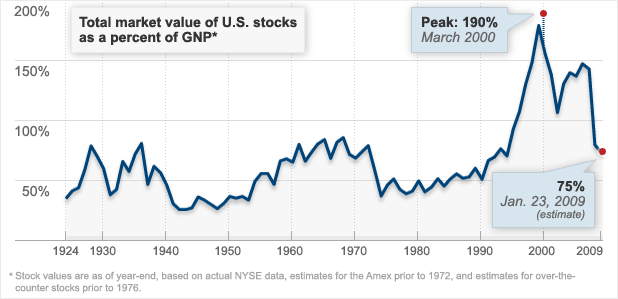
They quote the Sage of Omaha as saying "If the percentage relationship falls to the 70% to 80% area, buying stocks is likely to work very well for you."
Subscribe to:
Posts (Atom)


 Posts
Posts

